Google Sheets can do more than most people give it credit for. With the right setup, you can build functional dashboards directly inside a spreadsheet — no extra tools, no paid software.
But there’s a ceiling. And knowing where it is before you start saves you from rebuilding everything in six weeks.
Here are eight Google Sheets dashboard examples, how to build each one, and where Sheets starts to break down.
1. Sales Pipeline Dashboard
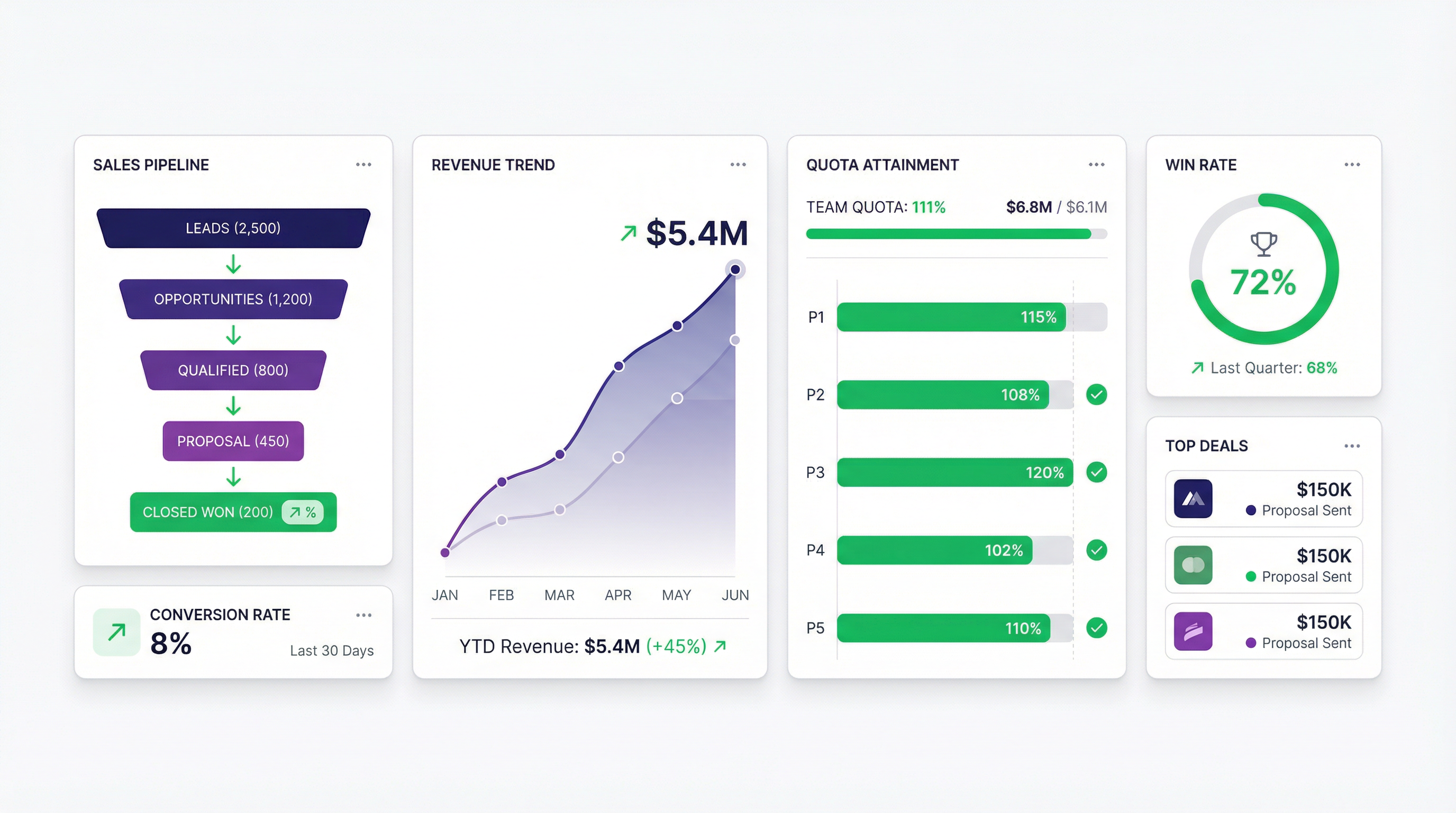
What it shows: Deal stages, total pipeline value, close rates, and deals by rep.
How to build it:
Set up your data tab with columns for Deal Name, Rep, Stage (Prospect / Qualified / Proposal / Closed Won / Closed Lost), Value, and Close Date. One row per deal.
On a separate Dashboard tab, use SUMIF to total pipeline value by stage. A stacked bar chart shows deal distribution. A COUNTIF formula gives you close rate — Closed Won divided by total deals.
For per-rep breakdowns, pivot tables work but get unwieldy past 10 reps. The cleaner approach: use QUERY() to pull each rep’s totals into a summary range, then chart that.
The catch: Sheets charts can’t reference more than 40,000 cells. If your CRM export is large, you’ll hit that wall. And there’s no drill-down — clicking a bar doesn’t filter anything else on the page.
2. Marketing Campaign Tracker
What it shows: Spend by channel, impressions, clicks, conversions, and cost per acquisition over time.
How to build it:
Structure your data with columns for Date, Channel, Spend, Impressions, Clicks, and Conversions. Add a calculated column for CPA: =Spend/Conversions.
Build a combo chart — bars for spend, line for CPA — grouped by channel. Use SPARKLINE() in cells next to each channel name for inline trend lines. These are genuinely useful for spotting patterns without building full charts.
Add data validation dropdowns to filter by date range. You’ll need a helper row with FILTER() that feeds the chart, and the chart references that filtered range.
The catch: The dropdown-filter-to-chart pipeline is fragile. One misaligned range reference and the whole thing breaks silently. Sheets also won’t auto-refresh data from external sources without Apps Script or a third-party connector.
3. Project Status Dashboard
What it shows: Task completion rates, overdue items, workload by team member, and timeline progress.
How to build it:
Your data tab needs Task, Assignee, Status (Not Started / In Progress / Done), Due Date, and Priority columns. Add a helper column: =IF(AND(Status<>"Done", Due Date<TODAY()), "Overdue", "On Track").
On the dashboard tab, use a donut chart for task status distribution. A horizontal bar chart shows tasks per assignee. Conditional formatting on a summary table highlights overdue items in red.
For a Gantt-style view, use SPARKLINE() with the {"charttype","bar"} option in individual cells. It’s hacky but effective for simple timelines.
The catch: This stops scaling around 200 tasks. Sheets recalculates every formula on every edit. With hundreds of COUNTIFS, SUMIFS, and conditional formatting rules, the sheet gets noticeably slow. And there’s no way to collapse or expand task groups interactively.
4. Financial Overview Dashboard
What it shows: Revenue vs expenses, profit margins, budget vs actuals, and monthly trends.
How to build it:
Two data tabs: one for revenue (Date, Source, Amount) and one for expenses (Date, Category, Amount). On a third tab, use SUMIFS to aggregate monthly totals for both.
A line chart shows revenue and expenses over time. A separate bar chart compares budget vs actuals by category. Use a scorecard-style layout at the top: big numbers in merged cells with CONCATENATE("$", TEXT(value, "#,##0")) formatting.
For variance analysis, add a column that calculates (Actual - Budget) / Budget and conditionally format it green/red.
The catch: Currency formatting across charts is inconsistent. Sheets sometimes drops the dollar sign on chart labels, or rounds figures unpredictably. And if you need to pull from multiple sheets or workbooks, IMPORTRANGE() adds latency — each linked range takes 3-5 seconds to refresh.
5. HR / People Dashboard
What it shows: Headcount by department, attrition rate, open positions, and time-to-hire metrics.
How to build it:
Your employee roster tab has Name, Department, Start Date, End Date (blank if current), and Role. A separate tab tracks open positions with Role, Department, Date Posted, and Date Filled.
Use COUNTA with FILTER to count active employees by department. Attrition rate: employees with an End Date in the last 12 months divided by average headcount. A pie chart (or better, a treemap chart if you’re on Workspace) shows department distribution.
For time-to-hire, calculate Date Filled - Date Posted for each filled position and average by department.
The catch: Sheets has no built-in treemap. You’re limited to pie charts, which get unreadable past six categories. And any dashboard containing employee data raises sharing concerns — Sheets permissions are all-or-nothing per sheet, not per chart.
6. Inventory Tracking Dashboard
What it shows: Stock levels by SKU, reorder alerts, turnover rates, and category breakdowns.
How to build it:
Data tab: SKU, Product Name, Category, Current Stock, Reorder Point, Units Sold (Last 30 Days), Unit Cost. Add a calculated column for Days of Stock Remaining: =Current Stock / (Units Sold / 30).
On the dashboard tab, conditional formatting is your best friend here. Color-code stock levels: red below reorder point, yellow within 20%, green above. A bar chart shows stock levels by category. A table with SORT() and FILTER() lists the 10 items closest to stockout.
The catch: This Google Sheets dashboard template works until you have more than a few hundred SKUs. Charts referencing large ranges slow down, and there’s no way to build an interactive search or filter without Apps Script. Scrolling through a table of 2,000 products in a spreadsheet isn’t a dashboard experience.
7. Customer Support Dashboard
What it shows: Ticket volume, resolution time, satisfaction scores, and agent performance.
How to build it:
Export your ticket data with columns: Ticket ID, Created Date, Resolved Date, Agent, Category, Priority, and CSAT Score. Calculate resolution time with a simple date difference.
Build a line chart for daily ticket volume. A bar chart ranks agents by average resolution time. For CSAT, use SPARKLINE() with a bar type to show each agent’s average score inline.
Add a QUERY() function to pull unresolved tickets older than 48 hours into a separate “Needs Attention” table. This is one of the most useful things you can build in Sheets — a live alert table that updates itself.
The catch: You need to manually re-export ticket data from your support tool. Unless you set up an Apps Script integration (which requires coding), this dashboard goes stale between exports. Sheets also can’t handle the volume if you’re processing thousands of tickets per week.
8. SaaS Metrics Dashboard
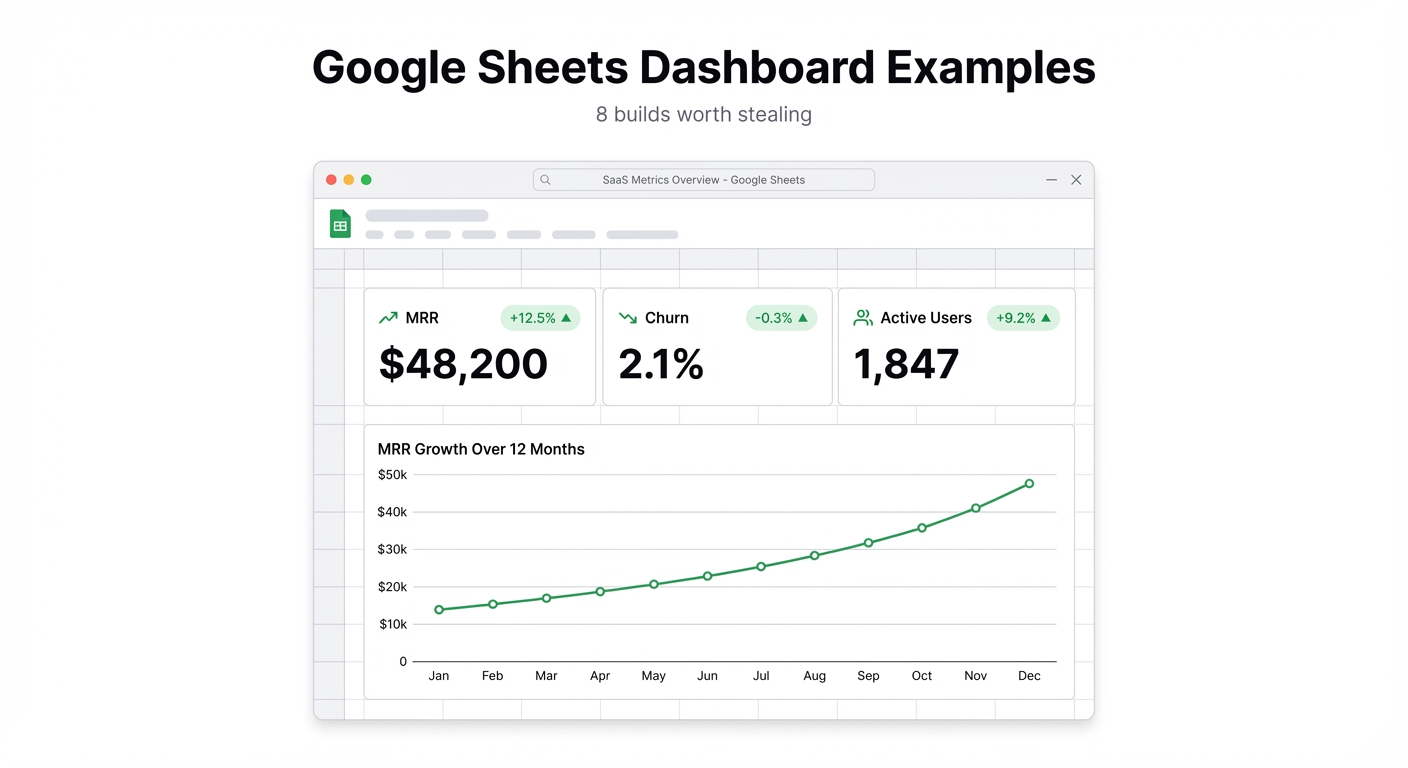
What it shows: MRR, churn rate, LTV, customer count, and growth trends.
How to build it:
Monthly data tab: Month, New MRR, Expansion MRR, Churned MRR, Total Customers. Calculate Net New MRR as New + Expansion - Churned. Running MRR is a cumulative sum.
Churn rate: Churned MRR / Previous Month Total MRR. LTV: Average Revenue Per Account / Monthly Churn Rate.
A combo chart works well here — bars for MRR components, line for total MRR trend. A separate line chart for churn rate over time. Scorecard cells at the top for current MRR, churn, and customer count.
The catch: Cohort analysis is nearly impossible in Sheets. If you want to see retention by signup month, you’re writing nested SUMPRODUCT formulas that nobody else on your team will understand or maintain. This is where Sheets as a dashboard tool hits its hard limit.
The Patterns That Keep Showing Up
After building all eight of these, the same problems surface:
Interactivity is limited. Sheets dashboards are static views. No cross-filtering, no drill-downs, no clicking a bar to see the underlying data. Dropdown filters with FILTER() ranges are the closest you get, and they’re brittle.
Charts have a 40,000-cell cap. Past that, the chart silently stops updating. No error message. Just stale data.
Sharing is all-or-nothing. You can share the whole sheet or nothing. There’s no way to show someone the dashboard without also exposing the raw data tabs, formulas, and structure. “Hide” a tab and any collaborator can unhide it.
Maintenance scales linearly. Every new metric means new formulas, new chart ranges, new things that can break. After a few months, nobody wants to touch the sheet.
When Sheets Isn’t Enough
These Google Sheets dashboard examples work for simple use cases. A team of five tracking 20 metrics with data that changes weekly. That’s the sweet spot.
Past that, you’re fighting the tool instead of reading the data.
Infograph connects directly to your Google Sheet. The live connection means the dashboard updates when the spreadsheet changes — no exports, no re-uploads, no Apps Script glue code. Describe the dashboard you want in plain language, and it builds the charts, layouts, and metrics for you.
Every example above takes less than a minute to build in Infograph. The sales pipeline dashboard? Prompt: “Show me deal value by stage, close rate trend, and pipeline breakdown by rep.” Done.
The free tier gives you one dashboard with a live Google Sheets connection. No credit card. If you’ve been maintaining a Sheets dashboard template and it’s starting to feel like a second job, this is worth ten minutes of your time.