The hardest part of building a dashboard isn’t the technical setup — it’s knowing what to put on it. Blank canvas, infinite options, and the pressure to get it right the first time.
Skip that. Here are 12 dashboard examples that work, what they show, and how to build them.
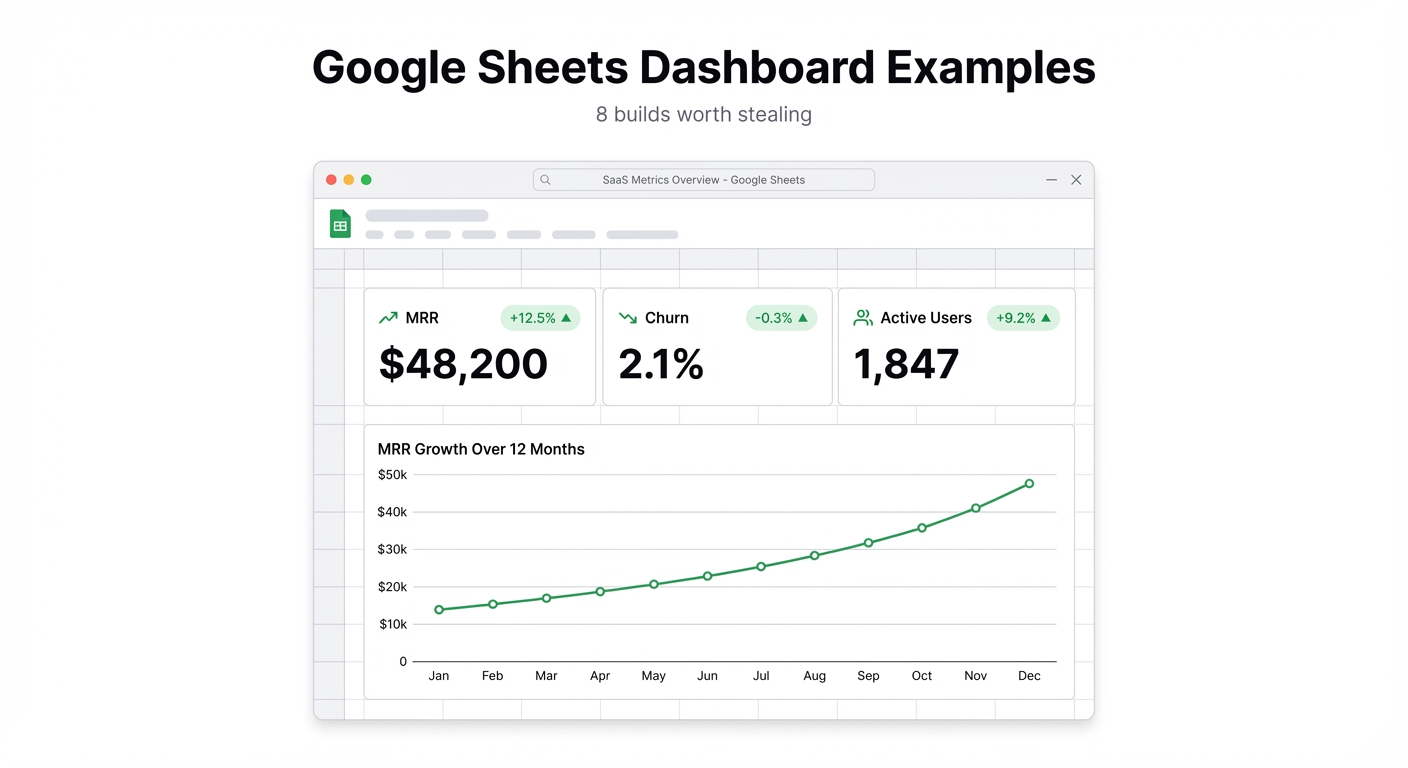
1. SaaS Metrics Dashboard
Who it’s for: SaaS founders and their leadership teams.
What it shows:
- MRR and ARR with month-over-month growth
- New MRR, expansion MRR, churned MRR (the “MRR movements” waterfall)
- Churn rate and net revenue retention
- Customer count by plan tier
- CAC vs LTV
Why it works: These are the numbers that actually tell you whether a SaaS business is healthy. Revenue alone lies — churn rate tells the truth.
2. Marketing Performance Dashboard
Who it’s for: Marketing teams and demand gen leads.
What it shows:
- Traffic by channel (organic, paid, social, email, direct)
- Conversion rate by source
- Cost per lead by campaign
- Lead volume vs target
- Email open rate and click rate trend
Why it works: Connects spend to output. Makes it obvious which channels are working and which aren’t.
3. Sales Pipeline Dashboard
Who it’s for: Sales managers and revenue teams.
What it shows:
- Pipeline by stage (funnel chart)
- Pipeline value by rep
- Win rate and average deal size
- Days in stage (where deals stall)
- Quota attainment by rep
Why it works: Most CRM dashboards show activity. This one shows momentum. “Days in stage” alone will change how your sales manager coaches.
4. Financial Overview Dashboard
Who it’s for: CFOs, founders, and board members.
What it shows:
- Revenue vs budget by month
- Gross margin trend
- OpEx breakdown by category
- Cash balance and burn rate
- EBITDA
Why it works: Replaces the monthly finance deck. Stakeholders open a link instead of waiting for someone to compile a PDF.
5. Ecommerce Performance Dashboard
Who it’s for: DTC brand operators and ecommerce managers.
What it shows:
- Revenue by channel (Meta, Google, email, organic)
- Conversion rate and cart abandonment rate
- Top products by revenue and margin
- Average order value trend
- New vs returning customer split
Why it works: Connects marketing spend to the outcomes that actually matter: orders, revenue, and margin.
6. Customer Support Dashboard
Who it’s for: Support team leads and CS managers.
What it shows:
- Ticket volume by day and category
- First response time and resolution time
- CSAT score trend
- Tickets by channel (email, chat, phone)
- Open vs resolved trend
Why it works: Support is often invisible until something breaks. A dashboard makes it visible before the breaking point.
7. Executive Overview Dashboard
Who it’s for: CEOs and leadership teams.
What it shows:
- Revenue vs plan (line with target)
- Gross margin
- Headcount vs plan
- Key operational metric (ARR, GMV, orders — pick one)
- Churn or retention rate
Why it works: One screen, five things, the entire business. Designed for the person who needs to make decisions, not the person who needs to analyze data.
8. HR and People Dashboard
Who it’s for: HR leaders and COOs.
What it shows:
- Headcount by department and location
- Monthly attrition rate
- Time to fill by role
- eNPS trend
- Headcount vs plan
Why it works: People data is often invisible outside of HR. This makes it a business metric, not just an HR metric.
9. Product and Engineering Dashboard
Who it’s for: Product managers and engineering leads.
What it shows:
- Sprint velocity over past 8 sprints
- Bug count by severity (open and resolved)
- Feature delivery rate vs roadmap
- Deployment frequency
- Incident count and mean time to resolve
Why it works: Engineering work is hard to make visible to non-technical stakeholders. This does it without requiring them to read a JIRA board.
10. Real-Time Operations Dashboard
Who it’s for: Operations teams tracking live activity.
What it shows:
- Today’s order or transaction count (vs yesterday and last week same day)
- Active users or sessions right now
- Error rate or system health indicator
- Queue depth or processing backlog
Why it works: Some teams need to see what’s happening right now, not just what happened last week. A live-connected dashboard that updates automatically delivers that.
11. Content Performance Dashboard
Who it’s for: Content teams and SEO managers.
What it shows:
- Organic traffic by page (top 20)
- Keyword rankings trend (for target terms)
- New posts published vs target
- Average time on page and bounce rate
- Social shares and backlinks acquired
Why it works: Content ROI is hard to see because results take time. A dashboard that shows organic traffic trends by page makes the long game visible.
12. Investor / Board Dashboard
Who it’s for: Founders preparing for board meetings.
What it shows:
- Revenue and growth rate (vs last period and vs same period last year)
- Gross margin
- Burn rate and runway
- Key milestones hit vs missed
- Top risks and blockers (text, not charts)
Why it works: Board members don’t want to dig. They want the story. A clean dashboard with five numbers and a risk list is better than a 40-slide deck.
How to build any of these
All of these dashboards follow the same pattern: get the data, connect it, describe what you want.
For most teams, the data lives in:
- An accounting system (QuickBooks, Xero) → export as CSV
- A CRM (HubSpot, Salesforce) → export contacts, deals, or pipeline
- A spreadsheet your team already maintains → connect via Google Sheets or Excel Online
- A platform analytics export (Shopify, Stripe, Google Analytics) → CSV download
Bring it into Infograph, describe the dashboard you want in plain English, and the AI builds it. Share it as a link with whoever needs it. Connect a live source and it stays current automatically.
Free plan lets you build your first dashboard today — no credit card required.
The best dashboard you’ll ever build is the one you actually use. Pick one of these, start there.